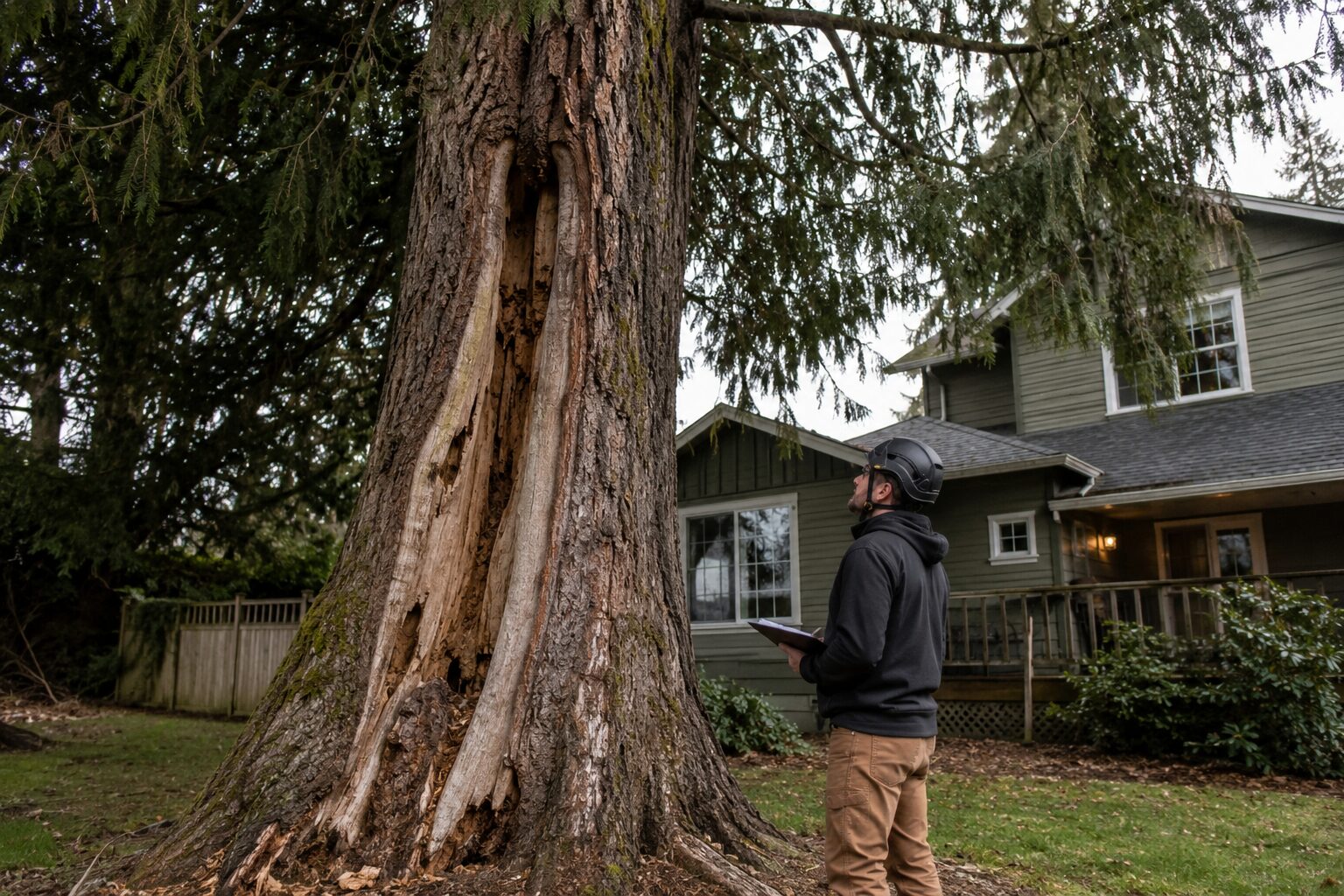
 Trees are one of the most valuable parts of many properties throughout the Pacific Northwest. Large mature trees provide beauty, shade, privacy, wildlife habitat, and long-term property value. In many cases, healthy trees can remain an important part of a landscape for generations.
Because of this, most property owners understandably prefer to preserve trees whenever possible. However, there are situations where tree removal becomes the safest and most practical option. The challenge is that many dangerous trees do not always look obviously hazardous until significant damage has already occurred.
Knowing when a tree should be removed is not always straightforward. Some trees can be preserved with pruning or maintenance, while others may pose increasing risks to homes, businesses, vehicles, power lines, and people. Understanding the warning signs of a declining or unstable tree can help property owners make informed decisions before problems become emergencies.
Dead Trees Become Increasingly Dangerous
One of the clearest signs a tree may need removal is when it has died completely.
Dead trees lose structural strength over time as the wood begins drying out, cracking, and decaying. Branches become brittle, trunks weaken internally, and root systems gradually lose stability. In the Pacific Northwest, heavy rain, windstorms, snow, and saturated soil can accelerate this deterioration.
Even small dead trees can become hazardous, but large mature trees pose especially serious risks when they fail.
Dead trees often show signs such as:
- No leaf growth during the growing season
- Large sections of missing bark
- Brittle or falling branches
- Fungal growth
- Hollow areas
- Extensive decay
- Significant dead canopy sections
Because dead trees become more unstable as time passes, removal is often recommended sooner rather than later.
Structural Damage Can Make Trees Unsafe
Trees may also require removal when they develop serious structural defects.
Over time, trees can experience:
- Large trunk cracks
- Splits
- Hollow sections
- Weak branch unions
- Significant lean
- Storm damage
- Broken major limbs
Some structural issues can be managed with pruning or cabling systems, but severe defects may compromise the tree’s overall stability.
A tree does not need to fall completely to create danger. Large limb failures alone can cause major damage to:
- Homes
- Vehicles
- Roofs
- Fences
- Utility lines
- Outdoor gathering spaces
Certified arborists evaluate both the severity of structural problems and the likelihood of failure when determining whether removal is appropriate.
Root Damage Often Leads to Long-Term Problems
Tree roots play a critical role in anchoring and stabilizing the tree. Unfortunately, root damage is one of the most overlooked causes of tree failure.
Roots may become damaged by:
- Construction
- Excavation
- Soil compaction
- Drainage changes
- Utility installation
- Disease
- Erosion
Because roots are underground, property owners often do not realize damage has occurred until the tree begins declining or leaning.
Signs of root instability may include:
- Leaning trees
- Raised soil near the base
- Fungal growth around roots
- Declining canopy health
- Cracks in the surrounding soil
In the Pacific Northwest, heavy winter rains can further weaken compromised root systems and increase the risk of sudden uprooting during storms.
Trees Too Close to Structures May Need Removal
Some trees eventually outgrow their location.
As trees mature, they may begin threatening:
- Roofs
- Foundations
- Driveways
- Retaining walls
- Septic systems
- Utility lines
- Neighboring properties
Large limbs overhanging homes may create ongoing safety concerns, especially during windstorms or winter weather.
In some cases, selective pruning can reduce risk temporarily, but removal may ultimately become the safest long-term solution when a tree is poorly positioned or continues creating structural concerns.
Disease and Decay Can Weaken Trees Internally
One of the biggest challenges with tree health is that decay often develops internally long before major symptoms appear externally.
A tree may still produce leaves and appear relatively healthy while internal decay weakens its structure from the inside out.
Certified arborists look for signs such as:
- Mushroom or fungal growth
- Hollow cavities
- Bark abnormalities
- Dead canopy sections
- Carpenter ant activity
- Cracks or seams in the trunk
Not all decay automatically requires removal, but severe decay significantly increases the likelihood of failure.
Professional evaluation helps determine whether a tree can safely remain or whether removal is the more responsible option.
Storm Damage Can Permanently Compromise Trees
Storms frequently damage trees throughout the Pacific Northwest.
Strong winds, saturated soils, snow loading, and ice accumulation can all create:
- Broken limbs
- Trunk fractures
- Split canopies
- Root instability
- Leaning trees
Some storm-damaged trees can recover with proper pruning and care. Others may become permanently weakened and dangerous even if they survive initially.
Trees with major structural damage often require professional evaluation after storms to determine whether they remain safe long term.
Sometimes Removal Is the Most Cost-Effective Option
While preserving trees is often desirable, there are situations where repeated maintenance becomes impractical.
Some trees may require:
- Frequent pruning
- Ongoing monitoring
- Cabling systems
- Storm cleanup
- Repeated hazard mitigation
If a tree continues posing elevated risk despite maintenance efforts, removal may become the safer and more cost-effective long-term solution.
Planned removal is also typically far less expensive and disruptive than emergency removal after storm failure.
Certified Arborists Help Property Owners Make Informed Decisions
Deciding whether a tree should be removed is rarely something property owners should guess at on their own.
Certified arborists evaluate:
- Tree species
- Structural integrity
- Root stability
- Environmental conditions
- Failure potential
- Nearby targets
- Long-term health outlook
In many cases, trees can safely remain with proper care and monitoring. In other situations, removal is the best way to protect people and property from future damage.
At New Day Arborist, professional tree evaluations help property owners throughout the Pacific Northwest better understand the condition of their trees and make informed decisions about safety, maintenance, and long-term landscape management.
Removing a hazardous tree is never a decision property owners enjoy making, but in the right circumstances, proactive removal can help prevent much larger and more dangerous problems in the future.