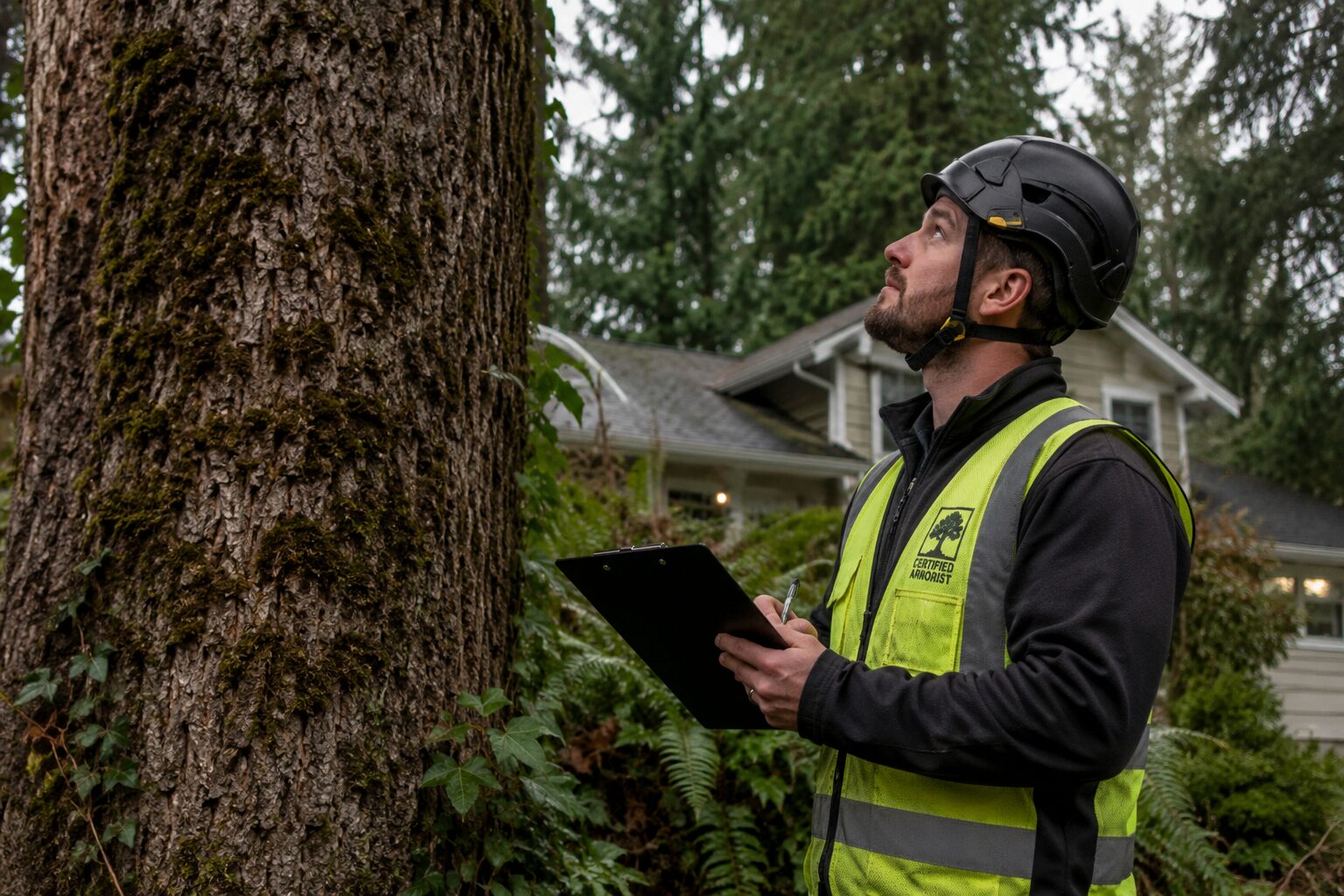
 Trees add beauty, shade, privacy, and value to properties throughout the Pacific Northwest. Mature trees can dramatically improve landscapes and create a sense of character that takes decades to develop. However, trees are also large living structures that can occasionally become hazardous when they develop structural weaknesses, disease, or instability.
One of the biggest misconceptions property owners have is believing that dangerous trees always show obvious signs before failing. In reality, many hazardous trees still appear healthy from a distance. Internal decay, root instability, and structural weaknesses can develop gradually and remain hidden until a storm, heavy rain, or strong wind causes sudden failure.
This is why professional tree risk evaluations are so important. Certified arborists are trained to assess trees for signs of instability, structural defects, disease, and environmental stress that may increase the likelihood of failure. A proper tree risk assessment helps property owners better understand the condition of their trees and make informed decisions about long-term safety and tree care.
Tree Risk Evaluation Is More Than Looking at a Tree
Many people assume evaluating tree safety simply involves checking whether a tree looks dead or alive. In reality, tree risk assessment is far more detailed and technical.
Certified arborists evaluate a wide range of factors, including:
- Tree species
- Age and growth patterns
- Structural integrity
- Root stability
- Signs of decay
- Soil conditions
- Environmental stress
- Nearby targets such as homes or power lines
- Weather exposure
- History of damage or pruning
The goal is not simply to decide whether a tree should be removed. In many cases, arborists help identify ways to preserve healthy trees while reducing potential risks.
The Root System Is One of the Most Important Areas Evaluated
A tree’s stability depends heavily on its root system.
Unfortunately, roots are also one of the hardest parts of a tree for property owners to evaluate because most of the root structure is hidden underground. Certified arborists look for signs that may indicate root problems such as:
- Soil movement
- Raised ground near the base
- Root decay
- Construction damage
- Poor drainage
- Soil compaction
- Fungus near the trunk base
- Leaning or shifting trees
Root problems are especially concerning because they can lead to complete tree failure. In the Pacific Northwest, saturated soils during heavy rains can further weaken unstable root systems and increase the risk of trees uprooting during storms.
Arborists Look for Structural Weaknesses
Tree structure plays a major role in long-term stability.
Certified arborists inspect the trunk and branches for defects such as:
- Cracks
- Cavities
- Weak branch unions
- Included bark
- Splitting
- Dead limbs
- Excessive lean
- Previous storm damage
Some trees naturally develop structural weaknesses as they age, while others become compromised due to improper pruning, storm exposure, or disease.
Even trees that appear healthy may contain hidden internal decay that weakens their structural strength over time.
Internal Decay Is Often Hidden
One of the most dangerous tree problems is internal decay.
Trees can slowly decay from the inside out while still producing leaves and appearing relatively healthy externally. Certified arborists are trained to recognize subtle indicators of decay such as:
- Fungal growth
- Hollow sounds
- Cavities
- Bark abnormalities
- Dead branch patterns
- Carpenter ant activity
- Mushroom growth near roots
Certain fungi are especially important warning signs because they indicate the wood inside the tree may already be weakening.
Internal decay does not always mean immediate removal is necessary, but it often requires closer monitoring and professional evaluation.
Species and Environmental Conditions Matter
Different tree species respond differently to environmental stress and aging.
In the Pacific Northwest, arborists frequently evaluate species such as:
- Douglas fir
- Western red cedar
- Bigleaf maple
- Cottonwood
- Alder
- Pine species
Each species has different strengths, weaknesses, growth habits, and failure tendencies.
For example:
- Some trees are more prone to root failure
- Others develop brittle limbs
- Some species tolerate moisture better than others
- Certain trees become hazardous more quickly with age
Certified arborists understand how local climate conditions, soil types, and species-specific traits affect overall tree risk.
Arborists Evaluate Nearby Targets
Tree risk is not only about the condition of the tree itself. Arborists also evaluate what could be damaged if the tree or a major limb were to fail.
Potential targets may include:
- Homes
- Garages
- Vehicles
- Power lines
- Roads
- Sidewalks
- Neighboring properties
- Outdoor gathering areas
A tree located deep in a forest may present little practical risk even if it has defects, while a similar tree overhanging a house may require immediate attention.
Risk evaluation considers both the likelihood of failure and the consequences if failure occurs.
Weather Exposure Plays a Major Role
Pacific Northwest weather creates unique challenges for tree stability.
Certified arborists consider:
- Wind exposure
- Soil saturation
- Snow and ice loading
- Drought stress
- Storm history
- Slope conditions
Heavy rain can saturate soil and weaken root anchoring. Strong winds place stress on large canopies, while snow and ice accumulation can overload limbs.
Trees that have survived storms for decades may still become vulnerable as conditions change or structural weaknesses develop over time.
Risk Assessments Help Prevent Emergencies
One of the most valuable benefits of professional tree risk evaluation is the ability to identify problems before they become emergencies.
Preventative tree care may include:
- Selective pruning
- Cabling or bracing
- Soil improvements
- Monitoring
- Weight reduction
- Removal of hazardous limbs
- Planned tree removal when necessary
Addressing issues early is often safer, less expensive, and less disruptive than dealing with emergency storm damage later.
Certified Arborists Help Property Owners Make Informed Decisions
Tree risk assessment is ultimately about helping property owners make educated, balanced decisions.
Not every tree defect requires removal. In many cases, proper maintenance and monitoring can safely preserve valuable trees for many additional years.
At New Day Arborist, professional tree risk evaluations help property owners throughout the Pacific Northwest better understand the condition of their trees while improving safety, protecting property, and supporting long-term tree health.
Regular inspections by a certified arborist provide valuable insight into hidden tree conditions and help reduce the risk of unexpected failures before they become dangerous problems.